Old vs New Tax Regime for FY 2026-27: Which One Saves You More?
By Byteary Team · Oct 3, 2026 · 5 min read
Every April your employer asks the same question: old regime or new? Pick the wrong one and you can pay tens of thousands of rupees more tax than you need to. The good news is that the answer is not a matter of opinion. It depends on one number - how much you can claim in deductions - and you can work it out in a few minutes.
This guide uses the rules for FY 2026-27 (assessment year 2027-28). Budget 2026 left the slabs unchanged from the previous year, so if you compared the regimes last year, the picture is much the same.
The two regimes in one minute
The new regime is the default. It has lower rates and more slabs, but you give up almost all deductions and exemptions. The old regime has higher rates, but lets you subtract things like 80C investments, health insurance, home loan interest and HRA before tax is worked out.
| Taxable income | New regime | Old regime (below 60) |
|---|---|---|
| Up to ₹2.5 lakh | 0% | 0% |
| ₹2.5 - 4 lakh | 0% | 5% |
| ₹4 - 5 lakh | 5% | 5% |
| ₹5 - 8 lakh | 5% | 20% |
| ₹8 - 10 lakh | 10% | 20% |
| ₹10 - 12 lakh | 10% | 30% |
| ₹12 - 16 lakh | 15% | 30% |
| ₹16 - 20 lakh | 20% | 30% |
| ₹20 - 24 lakh | 25% | 30% |
| Above ₹24 lakh | 30% | 30% |
Both add 4% health and education cess on top. Two other differences matter a lot:
- Standard deduction for salaried people: ₹75,000 in the new regime, ₹50,000 in the old.
- Section 87A rebate: in the new regime, no tax at all if taxable income is up to ₹12 lakh (with marginal relief just above it). In the old regime the rebate stops at ₹5 lakh.
Put together, a salaried person pays zero tax up to ₹12.75 lakh of salary in the new regime (₹12 lakh plus the ₹75,000 standard deduction).
Worked examples
These figures are for a salaried person below 60, including cess, calculated with the Income Tax Calculator. "Deductions" means everything you can claim in the old regime other than the standard deduction - 80C, 80D, home loan interest, HRA exemption and so on.
| Gross salary | New regime | Old, no deductions | Old, with deductions |
|---|---|---|---|
| ₹10 lakh | ₹0 | ₹1,06,600 | ₹0 with ₹4.5 lakh |
| ₹15 lakh | ₹97,500 | ₹2,57,400 | ₹1,40,400 with ₹3.75 lakh |
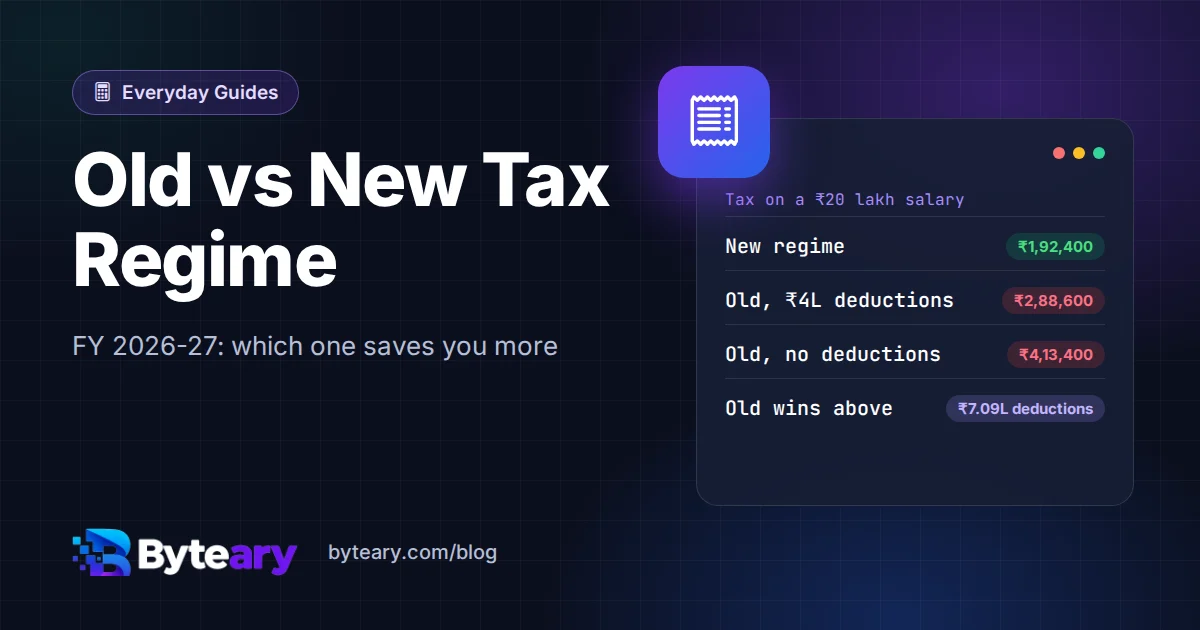
| ₹20 lakh | ₹1,92,400 | ₹4,13,400 | ₹2,88,600 with ₹4 lakh |
| ₹30 lakh | ₹4,75,800 | ₹7,25,400 | ₹5,38,200 with ₹6 lakh |
In every row above, the new regime comes out ahead. That is the pattern for most salaried people now: the new slabs are so much lower that ordinary deductions do not catch up.
The break-even point: how much you need to deduct
The old regime only wins when your deductions are larger than a certain amount. Below that, the new regime is cheaper; above it, the old one is.
| Gross salary | Old regime wins if deductions are more than about |
|---|---|
| ₹10 lakh | ₹4.5 lakh (and then both are zero) |
| ₹15 lakh | ₹5.44 lakh |
| ₹18 lakh | ₹6.42 lakh |
| ₹20 lakh | ₹7.09 lakh |
| ₹25-50 lakh | ₹8 lakh |
Now compare that with what most people can actually claim:
- Section 80C (EPF, PPF, ELSS, life insurance, children's tuition, home loan principal): up to ₹1.5 lakh
- Section 80CCD(1B), your own NPS contribution: up to ₹50,000
- Section 80D, health insurance: up to ₹25,000 for yourself, plus ₹25,000-₹50,000 for parents
- Section 24(b), interest on a home loan for a house you live in: up to ₹2 lakh
That adds up to roughly ₹4.25-4.75 lakh even if you max out everything. To cross the break-even, you usually also need a large HRA exemption - typically someone paying high rent in a big city - or both a home loan and high rent at different times of the year. Check your HRA figure with the HRA Calculator; from FY 2026-27, Bengaluru, Hyderabad, Pune and Ahmedabad count as metros (50% of basic) along with Delhi, Mumbai, Kolkata and Chennai.
Who should still choose the old regime?
- People paying a home loan and claiming a big HRA exemption, or with a very large HRA alone.
- Senior citizens with modest income who use the higher old-regime exemption limit and deductions such as 80TTB and 80D.
- Anyone whose deductions in the break-even table above are clearly exceeded - run your own numbers rather than going by a rule of thumb.
One deduction works in both regimes: your employer's contribution to NPS under Section 80CCD(2), up to 14% of basic pay in the new regime. If your company offers it, it is one of the few ways to cut tax in the new regime.
How to switch, and how often you can
If you have only salary income (no business income), you can choose the regime every year when you file your return - even if you told your employer something different for TDS. The employer's choice only decides how much tax they deduct each month; your final choice is made in the ITR.
People with business or professional income are more restricted: they choose the old regime by filing Form 10-IEA, and once they have left the new regime they can come back to it only once. The official rules are on the Income Tax Department website.
Check your own numbers in three minutes
- Open the Income Tax Calculator and enter your gross salary and any other income.
- Add up your old-regime deductions honestly - only what you will actually invest or pay this year.
- Compare the two totals side by side. The calculator also shows marginal relief and surcharge where they apply.
To see what lands in your bank account each month after tax, PF and professional tax, use the Salary In-Hand Calculator. And if a home loan is part of your plan, the EMI Calculator shows how much of each year's EMI is interest you could claim.
The short version
- Salary up to ₹12.75 lakh: the new regime, with zero tax.
- Above that: the new regime, unless your deductions beat the break-even for your salary - usually ₹5.5-8 lakh.
- Choose again every year; your situation changes, and so can the answer.
These are general rules for resident individuals. Your situation may include capital gains, rental income or other details that change the result, so check your return carefully or ask a tax professional for big decisions.